10 Tips for Sourcing Custom Leather Wallets
Sourcing Custom Leather Wallets requires more than choosing a color and adding a logo. A reliable process begins with clear product goals, practical measurements, and a realistic budget. Decide whether the wallet needs six card slots, a coin pocket, or a slim profile for front-pocket use. These small choices affect leather thickness, stitching, packaging, and production costs.
Experienced buyers usually request leather samples before approving a full order. Grain texture, edge finishing, and color can look different under warehouse lighting. Ask suppliers about leather origin, tanning methods, hardware quality, and quality-control procedures. A professional supplier should explain these details clearly and provide consistent sample information. Certifications and verifiable business records can also support a more trustworthy decision. Do not rely on attractive photographs alone.
Communication matters. Share a measured specification sheet, logo files, reference images, and acceptable tolerances. Then confirm the prototype before discussing mass production. Details matter. Even a slight card-slot misalignment can make a wallet feel cheap. I have seen sourcing plans focus heavily on appearance while ignoring packaging damage, lead times, and replacement policies. That approach needs reconsideration. A beautiful sample is not proof of stable production.
This guide presents ten practical tips for evaluating suppliers, materials, prototypes, pricing, and delivery. It also considers ethical sourcing, transparent communication, and responsible production expectations. The goal is not simply to find the lowest quote. It is to build a dependable supply relationship that protects quality, customer satisfaction, and long-term brand credibility.
Define Wallet Requirements, Target Users, and Customization Goals
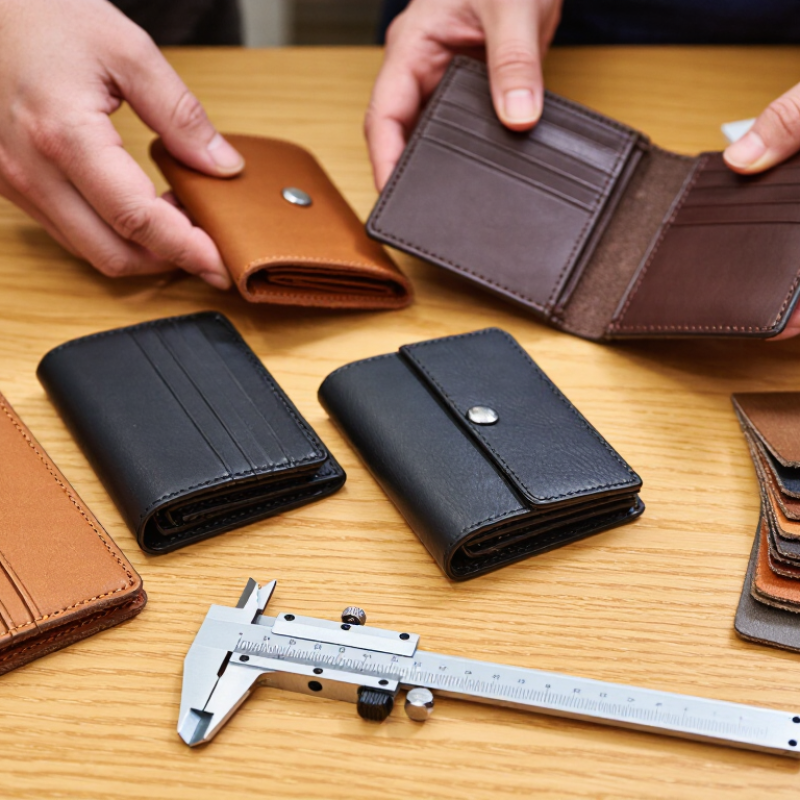
Before requesting samples, define the wallet’s job. Is it for commuters carrying transit cards, travelers needing a passport sleeve, or minimalists who want four card slots? Record dimensions, capacity, leather type, lining, stitching, closure, and target price. Add practical tests: cards should slide out without bending, and a folded bill should sit flat. Small details matter.
Tip: Write a one-page specification, then ask suppliers to confirm each item in writing. Separate must-haves from optional details, such as initials, edge paint, or a contrasting thread. McKinsey’s 2021 Next in Personalization report found that 71% of consumers expect personalized interactions, while 76% feel frustrated when they do not receive them. That finding supports thoughtful customization, but it does not mean every buyer wants a monogram. Ask actual users. A quick interview can expose a mismatch between a polished concept and daily use.
Tip: Build a simple user profile and rank customization goals by value, not novelty. For example, a slim wallet for front-pocket carry may need rounded corners and a secure card pocket more than decorative embossing. Request a prototype and test it with real cards and cash. Check the seam where the leather folds. It may look fine at first. Still, wear testing takes time, and a short test can miss issues. I have seen specifications become too ambitious; fewer, clearer options are often easier to sample consistently.
Compare Leather Types, Finishes, Hardware, and Construction Methods
When sourcing custom leather wallets, compare the hide, finish, hardware, and construction as one system. Full-grain leather keeps its natural surface, so scars and shade variation may remain visible. Corrected-grain leather looks more uniform, but heavy coatings can hide the material’s character. Ask suppliers for labeled samples, not photos alone. Bend each sample near a fold and inspect the color under daylight. Small differences matter.
Finishes affect both appearance and wear. A matte surface may show rub marks differently from a glossy, pigmented one. Test water spotting and color transfer on a spare swatch before approving production.
Hardware deserves the same scrutiny: check zipper action, edge smoothness, and plating consistency. Grand View Research estimated the global leather goods market at USD 468.5 billion in 2023, underscoring the scale of sourcing choices, not the quality of any individual wallet.
Request measurable specifications rather than relying on broad claims. Construction is easy to overlook. Compare turned edges with painted edges, and inspect stitch spacing around card slots. Ask for a sample opened and flexed repeatedly.
One seam may still fail. I would also record what the sample does poorly; that note can be more useful than a polished product photo.
Research Suppliers and Verify Their Manufacturing Capabilities
Build a shortlist of leather wallet suppliers by checking their actual production work, not just polished catalog photos. Ask which steps they handle in-house, such as cutting, edge painting, stitching, and final inspection. A smooth video call helps, but it proves little. Request a live walkthrough of the workshop, with close views of stitching machines, work-in-progress pieces, and storage areas. Ask for evidence.
Send a written specification for a sample wallet: leather thickness, lining material, pocket dimensions, thread color, and acceptable edge finish. Then compare the sample with the specification under natural light. Check whether card slots stretch evenly and whether folded edges feel smooth. Small flaws can reveal a rushed process. Ask how the supplier records defects and handles rework. A vague answer deserves a follow-up, not an assumption.
Verify stated capacity against recent production records, staffing, and equipment, while respecting confidential information. Ask for references from comparable orders and confirm the supplier’s role in each project. Request test pieces from more than one production run if consistency matters. I might still overvalue a tidy workshop; it does not guarantee every batch will match. That doubt is useful. Agree on measurable inspection points before placing a larger order, and document any changes to materials or construction.
Request Samples to Assess Craftsmanship, Functionality, and Durability
Custom wallets can look impressive in photos yet fail after weeks of use. Grand View Research estimates the global leather goods market reached about $407.4 billion in 2023. That scale increases supplier choices, but it also makes sample testing essential. Request at least three samples from the same production batch. Inspect the grain, edge paint, stitching, lining, and logo placement under bright light. A small wrinkle is not always a defect; uneven cutting is.
Tip 1: Test the wallet with real cards, cash, and coins. Check whether the slots stretch or become difficult to use. Fold it repeatedly and measure thickness before and after testing. ISO 5402-1 provides a recognized method for leather flex resistance, while ISO 11640 evaluates color transfer from rubbing. Ask the supplier for relevant test records, not vague claims. Reports may not match your exact leather, unfortunately.
Tip 2: Examine the weakest details first. Pull gently at thread ends, bend the corners, and open every pocket 100 times. Photograph each result and record the sample’s leather type, finish, hardware, and dimensions. The 2024 ThredUp Resale Report projects the global secondhand apparel market to reach $350 billion by 2028, reinforcing the commercial value of longer product life. Still, durability depends on construction, not leather price alone. A beautiful sample can hide inconsistent workmanship.
Custom Leather Wallet Sample Evaluation Priorities
Use physical samples to assess the areas that most directly affect wallet quality: construction, usability, finishing, and long-term durability. Each category is scored on a practical 10-point inspection scale.
A strong sample should show consistent stitching, clean edges, reliable hardware, adequate card capacity, and minimal deformation after repeated opening, loading, and folding tests.
Confirm Pricing, Minimum Orders, Lead Times, Packaging, and Quality Control
Sourcing custom leather wallets requires more than comparing a supplier’s first quotation. Ask for a complete price breakdown, including leather grade, lining, hardware, tooling, sampling, and shipping. A low unit price may hide expensive setup charges. Request prices for several order quantities. This reveals whether the supplier offers meaningful volume savings.
Confirm the minimum order quantity before approving a design. A small trial order may cost more, but it reduces risk. Ask for a written lead time covering sampling, production, inspection, and packing. Clarify what happens if materials arrive late. Dates should be realistic, not optimistic promises. I once accepted a short production schedule and underestimated sample revisions. The shipment was delayed. That mistake changed my purchasing process.
Packaging also needs precise specifications. Confirm wallet dimensions, protective wrapping, carton strength, labels, and moisture protection. Request photos of a packed carton before mass production. Quality control should include leather surface checks, stitching alignment, edge finishing, logo placement, snap strength, and color consistency. Use an approved sample as the reference standard. A supplier should explain inspection methods and defect tolerances clearly. Keep written records of every approved detail. Small differences become costly when hundreds of wallets are involved. Perfect consistency is difficult, so define acceptable variation before production begins.
| 10 Tips for Sourcing Custom Leather Wallets — Confirm Pricing, Minimum Orders, Lead Times, Packaging, and Quality Control | |||
|---|---|---|---|
| No. | Tip | What to Confirm | Practical Planning Reference |
| 1 | Define the leather specification | Specify leather type, grade, thickness, finish, color, and whether the material must meet particular chemical or restricted-substance requirements. | Request a labeled material swatch and written specification before approving a sample. Leather appearance and thickness can vary between batches. |
| 2 | Compare like-for-like pricing | Ask for a unit-price breakdown by order quantity and confirm leather, lining, hardware, logo application, packaging, tooling, and shipping terms included in each quote. | As an initial budgeting exercise, a simple custom wallet may fall around US$8–$20 per unit at a few hundred pieces, before freight, duties, and special materials. Actual quotes vary substantially by design and specification. |
| 3 | Confirm minimum order quantities | Check the MOQ per style, color, and logo treatment, and ask whether a mixed-color order is allowed. Confirm if a smaller trial order carries a surcharge. | A planning range of 100–500 pieces per style is common to investigate for custom production; the supplier’s actual MOQ depends on materials, production setup, and customization. |
| 4 | Get a complete sample plan | Confirm sample cost, shipping cost, number of revision rounds, whether the sample fee is credited against production, and the approval deadline. | Allow roughly 1–3 weeks for an initial prototype, plus transit time. Complex patterns, custom hardware, or material sourcing can extend the schedule. |
| 5 | Agree on production lead times | Ask when the lead-time clock starts and whether it begins after deposit, material approval, or final sample approval. Include production, inspection, and dispatch dates in the schedule. | For planning, allow about 30–60 days for a first production run after approvals; repeat orders may be faster if materials and components are available. |
| 6 | Approve a measurable specification sheet | Record finished dimensions, card-slot count, pocket depth, stitching color, edge finish, logo position, hardware finish, and acceptable measurement tolerances. | Use a signed-off “golden sample” and photographs with measurements as the production reference. State tolerances explicitly, such as ±2 mm where appropriate. |
| 7 | Set quality-control criteria | Define checks for stitching, edges, folds, alignment, stains, odor, card fit, and hardware operation. Agree how defects are recorded and resolved. | Request in-process checks and a final pre-shipment inspection. If using statistical sampling, agree on the inspection level and acceptance limits before production. |
| 8 | Specify packaging and labeling | Confirm individual protection, box or pouch material, inserts, barcode or care labels, carton quantity, and any packaging material requirements for the destination market. | Approve a packaging sample and carton dimensions before bulk packing. Ask whether packaging is included in the unit price or quoted separately. |
| 9 | Clarify payment and delivery terms | Confirm deposit and balance milestones, currency, quote validity, delivery term, named destination, export documents, and responsibility for freight, insurance, duties, and taxes. | Compare total landed cost rather than unit price alone. Keep payment milestones, delivery responsibilities, and remedies for late or nonconforming goods in writing. |
| 10 | Document approvals and changes | Keep the approved artwork, material details, sample sign-off, purchase order, inspection plan, and change requests together. Require written approval for substitutions. | Reconfirm cost and schedule after any change to leather, color, dimensions, logo, hardware, or packaging; even small changes can affect sourcing and production. |
Related Posts
-
2026 Top High End Leather Bags Trends You Need to Know?
-

Discover the Timeless Elegance of Leather Gifts: A Guide to Choosing the Perfect Artisan Piece
-
How to Choose the Perfect Luxury Leather Bag for Every Occasion
-
Ultimate Guide to Designing Custom Leather Products for Your Brand
-

Top 10 Leather Gifts for Every Occasion Why Choose Leather?
-
How to Choose Quality Leather Handbags for Your Style and Budget