

10 Best Interactive Light Sculptures for Global Buyers
Interactive Light Sculpture has moved beyond visual spectacle. Buyers now assess how light responds to movement, touch, sound, and surrounding space. For public venues, hotels, museums, and event teams, the right installation must also withstand repeated use. A glowing archway may look striking in a photograph, yet perform poorly in a crowded lobby. Small details matter.
The International Energy Agency reports that lighting accounts for about 15% of global electricity consumption and 5% of greenhouse gas emissions. This makes efficient light sources a practical consideration, not just a sustainability talking point. The IEA’s reporting also supports a broader shift toward efficient lighting technologies, though an installation’s actual energy use depends on its design, controls, and operating schedule. Buyers should request power specifications, material details, maintenance guidance, and clear information about sensors or control systems. The figures do not tell the whole story. They cannot predict visitor response or long-term reliability.
This guide introduces 10 interactive light sculptures for global buyers, with attention to visual impact, interaction style, installation needs, and practical upkeep. Some pieces invite visitors to step through changing colors; others react to a hand gesture or cast moving patterns across a wall. These distinctions affect where each work belongs. A quiet gallery has different needs from an outdoor festival. Not always obvious. Product claims should be checked against technical documentation and, where possible, a live demonstration. The best choice is not automatically the brightest or most complex. It is the work that fits its audience, site, and operating plan.
What Defines an Interactive Light Sculpture
An interactive light sculpture is more than an illuminated object; it responds to people, place, or changing conditions. Its form may include LEDs, sensors, reflective surfaces, moving parts, or programmable controls. The defining feature is a clear relationship between an audience action and a visible change. A hand near a sensor might soften a color, while footsteps could send a slow pulse across a wall. The response should feel intentional, not random. Small details matter.
Good design also considers how people discover that relationship. A sculpture can invite touch, movement, or shared participation without requiring a long instruction panel. Brightness, response time, viewing distance, and ambient light all affect whether the interaction feels legible. In a bright lobby, subtle gradients may disappear; in a dark gallery, abrupt flashes can feel tiring. These effects deserve testing at the intended site, ideally with visitors of different ages and mobility needs. Sensors can misread a crowded room. That is a real limitation, not a footnote.
For global buyers, practical engineering is part of the artwork. Ask how the piece handles heat, dust, humidity, cleaning, and continuous operation. Confirm power requirements, installation clearances, accessible controls, and a documented maintenance plan before purchase. A beautiful interaction that fails after a month is not successful. I would not treat every sensor-driven work as genuinely interactive; sometimes the response feels thin. Not always. The judgment depends on context, and experienced reviewers may disagree.
How Light, Sensors, and Audience Input Shape the Experience
Interactive light sculptures work best when visitors can read the invitation at a glance: step closer, raise a hand, or pause beneath a glowing arch. Proximity sensors can shift color as people approach, while depth cameras can turn a moving silhouette into ripples across a wall. The response should feel immediate. Even a short delay can make the sculpture seem unresponsive. Yet more sensors do not always create more wonder; too many reactions can feel noisy.
Grand View Research’s 2024 Interactive Display Market report estimated the market at about US$43.2 billion in 2023, with continued growth projected through 2030. This broad category is not a measure of public art, but it signals rising investment in responsive visual systems. For global buyers, ask suppliers how sensors perform in bright daylight, crowded galleries, and changing temperatures. Request tests with children, wheelchair users, and visitors moving at different speeds. The first prototype may still miss something.
Tips: Use one clear interaction before adding layers. Test sensor range in the actual venue. Keep a quiet mode for visitors who prefer to watch, and provide visible feedback so people understand what their movement changed. A small light pulse can help. Avoid assuming every audience wants to perform.
| Rank | Artwork | Artist / Creative Team | First Presented | Light and Sensor Approach | Audience Input | How the Experience Changes | Typical Setting | Planning Consideration for Buyers |
|---|---|---|---|---|---|---|---|---|
| 1 | Pulse Room | Rafael Lozano-Hemmer | 2006 | A room-scale array of 300 clear incandescent bulbs is paired with a pulse sensor. | A visitor places a hand on the sensor to register their heartbeat. | The bulbs flash to the visitor’s heartbeat, which is then stored as a repeating pulse as the light sequence moves through the room. | Indoor galleries, museums, and darkened event spaces. | Plan for controlled ambient light, safe visitor circulation, and regular inspection of the sensor and lighting system. |
| 2 | Vectorial Elevation | Rafael Lozano-Hemmer | 1999 | A coordinated array of 18 robotic searchlights projects beams into the night sky. | Participants use an online interface to compose light patterns. | Submitted designs change the arrangement of beams, making the public an active contributor to a large-scale urban display. | Large outdoor plazas or open urban sites with clear sightlines. | Requires substantial outdoor space, permissions, careful sightline planning, and coordination with local aviation and public-safety authorities. |
| 3 | Body Movies | Rafael Lozano-Hemmer | 2001 | Large-scale photographic portraits are projected onto an architectural surface, with lighting used to cast audience shadows. | Passersby move through the projection area and shape the shadows on the wall. | Portraits are revealed or obscured by the size and position of participants’ shadows, turning ordinary movement into part of the image. | Public squares, building façades, and other large projection surfaces. | Allow room for a projection surface and a broad audience area; ambient light and the surface’s texture affect visibility. |
| 4 | The Pool | Jen Lewin | 2008 | A field of illuminated, pressure-sensitive circular platforms responds to people standing and moving on it. | Visitors step, walk, or dance across the platforms. | Footsteps trigger changing colors and patterns, so the display develops through individual and group movement. | Public plazas, cultural venues, and spacious indoor or outdoor event areas. | Assess floor levelness, accessible routes, weather exposure for outdoor installations, and safe capacity for simultaneous visitors. |
| 5 | Volume | United Visual Artists | 2006 | An array of suspended illuminated columns combines light and sound with motion tracking. | Visitors walk through the installation and change position within the array. | Tracked movement influences the light and sound response, making the installation feel different from changing viewpoints and paths. | Indoor galleries, performance spaces, and controlled exhibition environments. | Check ceiling height, rigging capacity, visitor flow, and the acoustic conditions needed for a combined light-and-sound work. |
| 6 | The Treachery of Sanctuary | Chris Milk | 2012 | A three-panel projection installation uses motion tracking to respond to visitors’ silhouettes. | Participants face the screens and move their bodies and arms. | The projected figures respond to the visitor’s outline, developing through a sequence involving human, winged, and bird-like forms. | Large indoor galleries or event venues with sufficient viewing distance. | Provide a clear interaction zone, unobstructed camera views, and enough space for several visitors to engage without blocking one another. |
| 7 | Frequency and Volume | Rafael Lozano-Hemmer | 2003 | Projected light and shadows are combined with radio-frequency signals and audio. | Visitors move their shadows through the projected field to interact with radio frequencies. | Body position affects the displayed frequencies and the associated sound, connecting movement with an audiovisual response. | Indoor exhibition spaces with room for projection and a clearly defined visitor zone. | Confirm that the venue can support the work’s audio requirements and that local radio regulations are addressed for the chosen configuration. |
| 8 | Text Rain | Camille Utterback and Romy Achituv | 1999 | Projected letters fall across a screen area, with a camera system tracking visitors’ silhouettes. | Visitors stand beneath the projection and use their bodies to catch or support letters. | Letters appear to rest on the outline of a person, turning body position into a way to explore fragments of text. | Indoor galleries, libraries, and educational spaces with a projection wall. | Use a controlled projection environment and leave enough floor area for viewers to move safely in front of the screen. |
| 9 | Shadow Monsters | Philip Worthington | 2004 | A camera-based system transforms projected audience shadows into animated, creature-like forms. | Visitors use their hands and bodies to create and alter shadows. | Gestures change the shape and behavior of the projected figures, making play and movement central to the work. | Interactive galleries, family venues, and public engagement spaces. | Ensure the camera can see participants clearly, provide a suitable projection surface, and consider supervision in high-traffic settings. |
| 10 | Boundary Functions | Scott Snibbe | 1998 | An overhead tracking system controls lines projected onto the floor around participants. | Visitors walk through the projected area, alone or in groups. | Lines redraw boundaries between people as their positions change, making the audience’s spatial relationships visible. | Indoor galleries and other spaces with a clear, walkable floor area. | Prioritize a flat projection surface, accessible circulation, and camera placement that can cover the entire interaction area. |
Criteria for Comparing Sculptures Across Global Markets
Comparing interactive light sculptures across markets starts with the room, not the render. Measure ceiling height, daylight, viewing distance, and available power at the actual site.
The 2023 Global Status Report for Buildings and Construction, published by UNEP and GlobalABC, reports that buildings use 34% of global energy and produce 37% of energy- and process-related CO₂ emissions.
That makes operating load a practical comparison point, not a decorative specification. Ask for measured wattage, standby draw, dimming range, and heat output. Details matter.
The International Energy Agency estimates that lighting represents about 15% of worldwide electricity use and 5% of greenhouse-gas emissions. Compare light output and control behavior alongside energy use.
Test a slow color transition, sensor response, and glare from seated and standing positions. Confirm voltage and frequency compatibility, replacement-part availability, ingress-protection documentation, and local service capacity before shipping.
Request installation photographs, not only polished renders. Specifications can omit calibration time or software support, and that gap can distort budgets.
Cultural fit matters too: brightness, color, and interaction cues may read differently across audiences. Let local users test the sculpture before final placement.
Ten Standout Interactive Light Sculptures for Global Buyers
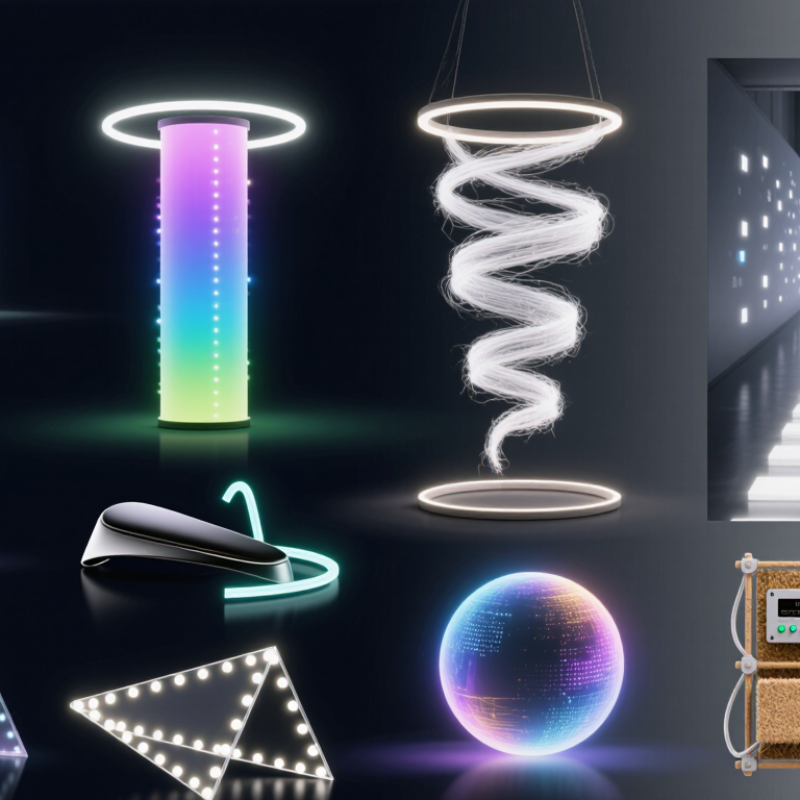
Ten standout interactive light sculptures offer more than visual impact; they invite people to change what they see. A responsive arch brightens as visitors pass beneath it. A mirrored column breaks one silhouette into many. A floor grid sends soft rings outward with each step. Kinetic pendants shift slowly, casting moving patterns across nearby walls.
Sound-reactive panels turn quiet voices or music into waves of color. A touch-sensitive orb glows beneath a palm, making interaction easy to understand. Shadow canopies project crisp outlines onto the ground at dusk. Data ribbons translate changing information into gentle pulses, though visitors may not always know what the colors mean. Wave-like light sculptures create a flowing effect without actual water. An illuminated bench responds when someone sits down. Small details matter.
For global buyers, practical testing matters as much as appearance. Check brightness in daylight, surface temperature after hours of use, and how controls work for children, older adults, and wheelchair users. Ask how components are serviced and whether replacement parts can be sourced locally. A beautiful installation can still frustrate people if its sensors miss slow movements or its instructions are unclear. That part is easy to overlook. In some spaces, a simpler interaction may feel more welcoming than a complex show.
Key Factors in Sourcing, Shipping, and Installing Light Sculptures
Global buyers comparing interactive light sculptures should look beyond brightness and visual impact. Ask how sensors respond to movement, ambient light, and crowded rooms. Request control-system specifications, electrical requirements, installation drawings, and a spare-parts list before ordering. Confirm whether lighting modules can be replaced individually; one failed component should not require dismantling the whole sculpture. Check finish samples under warm and cool light. Photos can flatten color, a detail buyers sometimes overlook.
Shipping plans need the sculpture’s packed dimensions, total weight, and handling instructions. Custom crates, moisture barriers, and clear lifting points can reduce damage during long transfers. Confirm delivery access, unloading equipment, and the receiving site’s storage conditions before dispatch. For installation, have a qualified local professional review floor loading, anchors, power access, and cable routes. Interactive pieces may also need network access or sensor calibration. Leave time for testing on site; a unit that works in a workshop may behave differently in a bright lobby. These checks take effort, and not every issue can be predicted.
Tips: Photograph each crate before opening, keep hardware labeled, and test every interaction after installation. Record settings and spare-part details for future maintenance. Don’t assume the first setup is the final one.

