



Top Fishing Tackle Manufacturers in China for Global Buyers
Fishing tackle buying is shaped by active anglers, product performance, and dependable supply. The American Sportfishing Association’s 2024 Special Report on Fishing estimated that 57.7 million Americans fished in 2023. That is a substantial audience. For global buyers, the figure signals why consistent quality and reliable replenishment matter across rods, reels, lines, lures, and other FISHING TACKLES.
China is an important sourcing base, but supplier selection should go beyond a polished catalogue. Buyers can compare manufacturing capabilities, product testing, material specifications, order flexibility, and export experience. A reel may look solid in a product photo; its drag performance and corrosion resistance matter more on the water. The Grand View Research fishing equipment market report offers a useful view of product and regional trends, though market estimates cannot verify an individual factory’s claims.
Ask for current samples and clear specifications. Check packaging, tolerances, and lead times before placing a large order. Small details count. A line’s stated breaking strength, for example, should be supported by consistent testing, not just a label. These checks are practical, yet they are not perfect; samples may not represent every production run. Independent inspections and written quality criteria can reduce that uncertainty. This guide introduces Chinese manufacturers and sourcing considerations to help buyers make informed comparisons, not assume that one supplier fits every market.
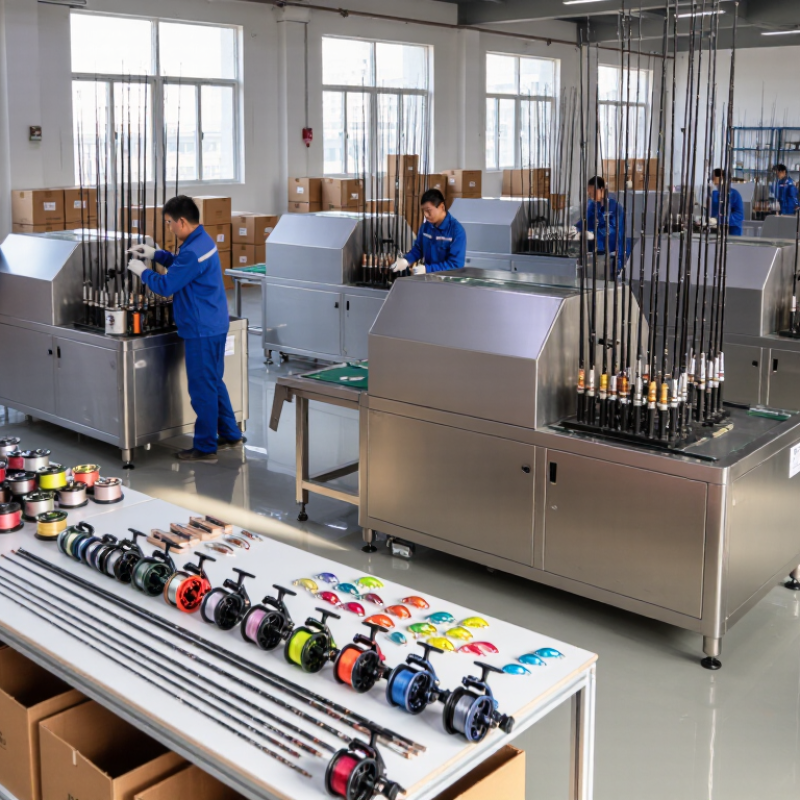
Table of Contents [Hide]
China’s Fishing Tackle Manufacturing Landscape
China’s fishing-tackle sector serves buyers seeking both specialist products and broad product ranges. Factories make rods, reels, hooks, lines, nets, and storage items, with capabilities varying across workshops and larger production sites. That mix matters. One supplier may handle rod blanks and assembly, while another provides coatings or packaging. Buyers should check samples, material specifications, production lead times, and inspection records before placing repeat orders. A polished sample alone may not represent a full production run.
The FAO’s 2024 State of World Fisheries and Aquaculture reports 223.2 million tonnes of global fisheries and aquaculture production in 2022, including 94.4 million tonnes of farmed aquatic animals. These figures show the scale of aquatic food production, not fishing-tackle sales; they should not be treated as a direct demand forecast. Recreational participation and replacement cycles also shape tackle demand. For supplier comparisons, UN Comtrade’s HS 9507 category covers fishing rods, hooks, and related tackle, offering a useful trade-data starting point. It does not reveal factory-level quality or capacity. Ask for product-specific test records, clear tolerances, and traceable material details. Small gaps in documentation can become expensive later.
Top Fishing Tackle Manufacturers in China for Global Buyers — China’s Fishing Tackle Manufacturing Landscape
| Product Category | Common Materials | Typical Manufacturing Processes | Key Buyer Specifications | Practical Quality Checks |
|---|---|---|---|---|
| Fishing rods | Carbon-fiber or fiberglass composites; metal guide frames; cork, EVA foam, or molded polymer handles | Composite blanks are formed and cured, then fitted with guides, reel seats, handles, and finishing components. | Length, power, action, line rating, lure rating, blank material, guide configuration, handle design, and target fishing method | Check straightness, guide alignment, joint fit, finish consistency, and performance against the agreed flex and load specifications. |
| Fishing reels | Aluminum alloys, engineering polymers, stainless steel, brass, and other corrosion-resistant metals | Parts may be die-cast, machined, molded, stamped, or assembled; gears, bearings, drag systems, and handles are fitted and tested. | Reel type, gear ratio, retrieve direction, line capacity, bearing configuration, drag rating, body material, and saltwater-use requirements | Test smoothness, gear engagement, drag consistency, handle security, spool alignment, and operation after exposure to the specified conditions. |
| Hooks and terminal tackle | High-carbon steel or stainless steel; finishes may include plating or protective coatings. | Wire is formed, points are shaped, hooks are heat-treated, and finishes or barbs are applied according to the design. | Hook style, size, wire gauge, point and barb design, coating, corrosion resistance, and applicable destination-market requirements | Inspect point sharpness, dimensional consistency, coating coverage, rust resistance, and strength using an agreed test method. |
| Fishing line | Nylon monofilament, fluorocarbon, and braided high-strength polyethylene fibers | Line is extruded or fiber-braided, then wound onto spools and labeled with the agreed specifications. | Line type, diameter, breaking strength, length per spool, color, stretch characteristics, knot performance, and packaging | Verify diameter and breaking strength with agreed sampling procedures; check spool length, winding quality, and label accuracy. |
| Lures and baits | Hard plastics, soft PVC or other elastomers, wood, metal, paint, hooks, and connecting hardware | Depending on the design, components may be molded, machined, painted, printed, assembled, and fitted with hooks or split rings. | Lure type, dimensions, weight, color, buoyancy or sinking behavior, hook configuration, materials, and packaging | Check finish and assembly, confirm weight and dimensions, and test swimming or action characteristics against an approved sample. |
| Landing nets and fishing tools | Nylon or polyester mesh; aluminum or stainless-steel frames; molded polymer, metal, or composite handles | Mesh is cut and joined to frames; handles and tool components are formed, assembled, and finished. | Net opening and mesh size, handle length, frame dimensions, material, folding design, corrosion resistance, and intended use | Inspect seams, frame joints, handle locks, moving parts, surface finish, and resistance to the handling conditions specified by the buyer. |
Specifications and test methods vary by product design and destination market. Buyers should confirm materials, tolerances, labeling, packaging, and acceptance criteria in the purchase agreement and approved samples.