

What Does Monthly Capacity 10M+ Balls Mean for Buyers?
Monthly Capacity 10M+ Balls is a striking claim, but buyers should treat it as a production figure to verify—not a guarantee of timely, consistent deliveries. At ten million balls over a 30-day month, the implied pace is about 333,000 balls each day. The number sounds decisive. It is only a starting point. Buyers need to know which ball types, sizes, materials, and production shifts the figure covers. A line making one standard model may not maintain the same output across several custom designs.
Demand figures offer context, but not a direct forecast. The SFIA 2024 Topline Participation Report estimated that 242.4 million Americans took part in at least one sport or fitness activity in 2023. That broad measure does not show how many balls they bought. It does, however, underline why suppliers must match production claims to real market needs. Quality also matters. FIFA’s Quality Programme for Footballs sets testing requirements for footballs; those criteria do not automatically apply to every kind of ball. Ask for product-specific inspection records, recent shipment evidence, defect rates, and lead times. Request a production plan showing how the factory handles peak orders and material delays. Capacity may be impressive on paper. The uncomfortable question is whether it is repeatable. A supplier’s clear, documented answer is more useful than a large headline figure.
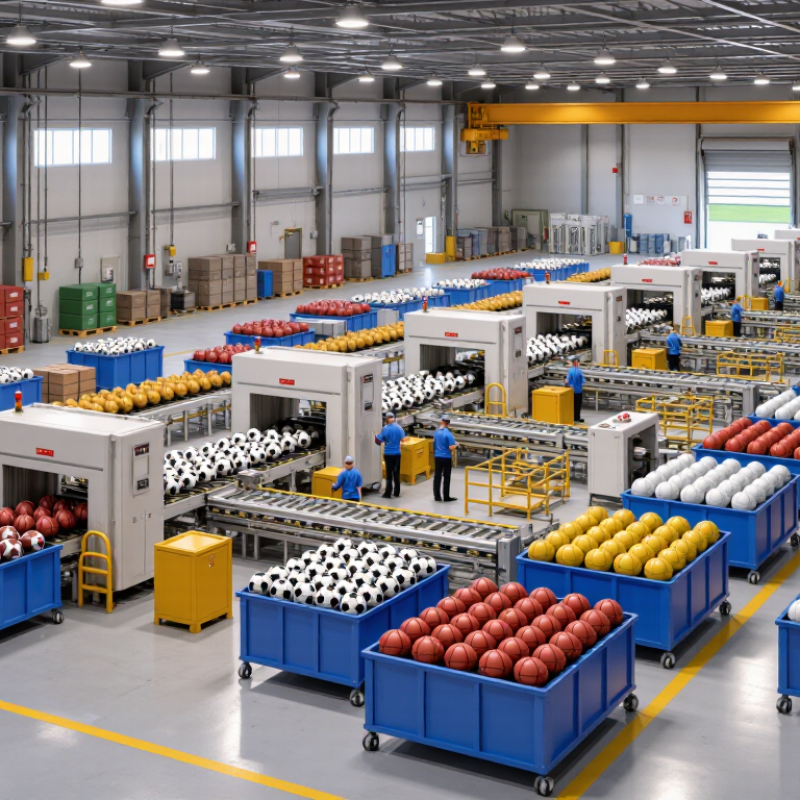
What “10M+ Balls per Month” Means in Manufacturing Terms
In manufacturing terms, “10M+ balls per month” usually describes a facility’s stated output capacity, not a promise that every order will ship at that volume. The figure depends on the product, production schedule, and how the factory counts finished units. A small, uniform ball may move through a line much faster than a larger or more demanding design.
Consider a line producing 400,000 balls per day across 25 working days. That reaches 10 million only if equipment runs consistently and most units pass inspection. Changeovers between sizes, color batches, or packaging formats can reduce the actual count. So can maintenance, rejected pieces, and shortages of materials. Small interruptions add up.
Ask what the number includes. Does it refer to one production line or the whole site? Is it based on one shift, several shifts, or continuous operation? A useful capacity report should name the product specification, measurement period, and whether it counts gross production or saleable output. Buyers can also compare the stated rate with recent production records and sample inspection results. The paperwork may look precise; real output still varies. A little skepticism is healthy.
How Monthly Production Capacity Is Measured
Monthly capacity is a rate, not a promise of monthly shipments. The Federal Reserve’s G.17 Industrial Production and Capacity Utilization report measures utilization by comparing actual output with estimated capacity. A ball factory can apply the same logic: calculate the line’s theoretical output, then account for operating time, changeovers, maintenance, and rejected units.
For example, a mold producing eight balls every 12 seconds can make about 2,400 balls per hour. At 20 operating hours daily for 26 days, one line’s theoretical monthly capacity is 1.248 million balls. Eight such lines approach 10 million before downtime or defects.
That distinction matters. Buyers should ask whether “10M+” means theoretical capacity or accepted, saleable products. They should also request the measurement period, shift pattern, product mix, and recent utilization figures. A month with frequent color changes may produce less than a steady run. And a neat spreadsheet can still hide bottlenecks. The Federal Reserve’s utilization framework is useful, but a buyer should check how the factory defines capacity and counts finished goods.
Which Factors Determine a Factory’s Output
What Does Monthly Capacity 10M+ Balls Mean for Buyers?
Which Factors Determine a Factory’s Output
A stated capacity of 10 million balls per month is a production estimate, not a shipment guarantee. Actual output depends on available machine hours, staffing, materials, and the product being made. A simple ball may move through molding and finishing faster than a design with extra layers, printing, or tight weight tolerances. Small changes add up.
Line speed matters, but so does time between batches. Workers may need to change molds, adjust settings, clean equipment, or wait for components. If one line pauses, nearby processes can build a queue. A factory running several shifts may still lose hours to maintenance or unexpected defects. The calendar looks neat. Production rarely does.
Quality checks also shape usable output. Sampling, pressure tests, weight checks, and visual inspection can identify balls that need rework or must be rejected. Buyers should ask whether quoted capacity means theoretical line capacity, finished goods, or products that pass inspection. They can also request recent monthly output ranges, lead times, and the assumptions behind the figure. These details are more useful than a headline number alone. Even then, forecasts can miss. A sudden material delay or a more demanding specification may change the schedule.
| Capacity Measure | Illustrative Calculation or Input | What Buyers Should Understand |
|---|---|---|
| Monthly saleable output | 10,000,000 finished balls in a stated production month | Ask whether the figure means finished, quality-approved units or total units started. Confirm the product type and operating schedule behind the claim. |
| Production days | At 24 working days per month: about 416,667 saleable balls per working day | The daily rate changes with the number of operating days. Planned maintenance, holidays, and order changeovers can reduce available production time. |
| Shift hours | At two 8-hour shifts for 24 days: 384 scheduled hours per month, or about 26,042 saleable balls per scheduled hour | Scheduled hours are not necessarily productive hours. Breaks, cleaning, setup, equipment stops, and material shortages affect actual output. |
| Quality yield | At an illustrative 90% first-pass yield, producing 10 million saleable units requires about 11.11 million units to enter production | Yield varies by product, process control, materials, and inspection criteria. Ask how defects, rework, and rejected units are counted. |
| Product mix and construction | Different ball sizes, materials, constructions, and specifications can require different process steps and cycle times | A capacity figure for one standard model may not apply to a mixed order or a more complex specification. Request capacity for the exact product mix. |
| Equipment and bottlenecks | Output is limited by the slowest required process step and the available equipment at that step | Ask for line-level capacity and identify bottlenecks, including forming, stitching or bonding, finishing, inspection, and packing, as applicable to the ball type. |
| Labor and line balance | Available trained operators, workstation layout, and task balance determine how consistently a line can run | More machines alone do not guarantee higher output. Staffing, skills, supervision, and balanced workstations also matter. |
| Downtime and changeovers | Maintenance, breakdowns, model changes, and cleaning reduce productive time | Request actual production records over a representative period, not only a theoretical maximum or a short peak run. |
| Capacity verification | Compare stated capacity with recent output, inspection results, and the proposed order schedule | These calculations are illustrative planning examples, not universal factory benchmarks. Confirm the basis, product scope, working calendar, and quality definition directly with the supplier. |
How High Capacity Can Affect Buyer Orders and Lead Times
A stated monthly capacity of 10 million-plus balls can give buyers room to place larger orders or split demand across repeat shipments. But capacity is a factory-wide figure, not a reserved slot for one customer. It may include several sizes, colors, and production lines. Ask how much output is already committed, and whether your specification needs dedicated tooling or extra inspection. Details matter. A 300,000-ball order with custom packaging may move differently from a standard bulk run, even when the factory has spare volume.
High capacity can shorten lead times when materials, labor, and packing schedules are aligned. It can also support staggered deliveries, helping buyers avoid filling a warehouse all at once. Still, a large monthly number does not remove bottlenecks. A delayed material shipment, color approval, or failed quality check can pause a batch. Not automatic. Ask for a written timeline showing sample approval, production, inspection, packing, and dispatch dates. Request updates against milestones, not only a broad delivery estimate. Forecasts can still shift. Plan a buffer before seasonal demand, and confirm whether quoted lead time begins after deposit, artwork approval, or final sample sign-off. That small distinction is often missed.
What Buyers Should Verify When Evaluating Capacity Claims
A monthly capacity claim of 10M+ balls sounds impressive, but buyers need to know what the figure actually counts. Ask whether it refers to finished, saleable units or every ball produced before inspection. Clarify the product size, material, and specification used for the estimate. A line running small, standard balls may produce at a different rate from one making larger or custom parts. The number needs context.
Request a capacity breakdown by machine, shift, and working days per month. Then compare it with recent production records, not just a forecast or a best-case test. Ask how many units typically fail inspection, and whether packaging, changeovers, or maintenance are included in the calculation. A short trial run can help: record output over several hours, check sample quality, and compare both results with the quoted monthly figure. Not proof by itself.
Buyers should also check whether the quoted capacity is available for their order. Existing commitments may already use much of the production schedule. Ask for a realistic lead time, the planned allocation, and how output changes when specifications vary. I would not treat one large number as a guarantee. It may be accurate under specific conditions, but those conditions matter. Even a clear capacity sheet can leave questions unanswered, so verify the details against production evidence and a sample order.

