

Why Choose a Covered Casserole Pan for Global Sourcing?
Choosing the right cookware for international markets requires more than comparing prices. A Covered Casserole Pan must combine dependable performance, safe materials, and practical packaging. Buyers also need confidence in the supplier behind the product.
In professional sourcing work, details often reveal quality. Check the pan’s base thickness, lid fit, handle strength, and heat distribution. A poorly fitted lid may release steam unevenly during cooking. That small problem can damage customer trust. Material declarations and production records should be reviewed before placing large orders. Independent testing can also verify coating durability, food-contact safety, and resistance to repeated heating.
Packaging deserves equal attention. A heavy pan needs protective inserts, clear labeling, and cartons tested for long-distance handling. Reliable suppliers should explain their inspection process, production capacity, lead times, and corrective actions. Factory audits and sample comparisons can reduce avoidable risks. They cannot remove every risk.
Global sourcing is rarely perfect. A supplier may offer excellent cookware but lack flexible packaging options. Another may provide attractive pricing but inconsistent finishing. These trade-offs require careful evaluation, not quick decisions. Buyers should compare total landed cost, not only the factory quotation. This includes freight, inspection, packaging, taxes, and possible replacement costs. With disciplined research, a Covered Casserole Pan can support consistent retail quality and stronger customer confidence across different markets. There is still room to improve.
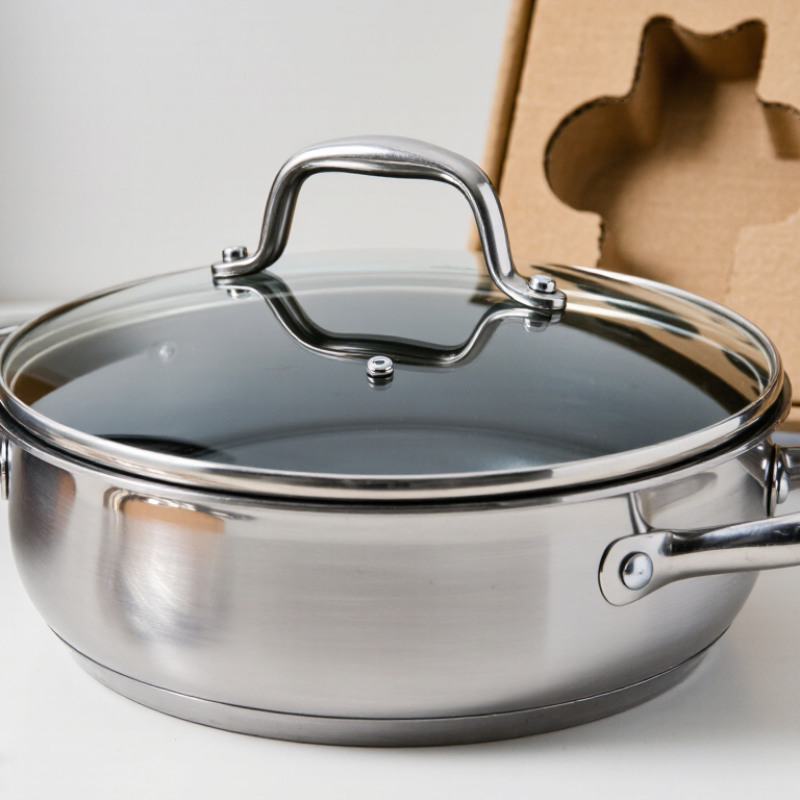
What Is a Covered Casserole Pan?
A covered casserole pan is a deep cooking vessel designed for baking, braising, simmering, and serving. Its matching lid helps retain moisture, heat, and natural flavors during longer cooking. Common materials include cast iron, stainless steel, aluminum, ceramic, and coated metal. Each material behaves differently under heat.
The pan usually has two side handles for safer lifting. Some designs include a broad base for stable stovetop heating. A well-fitted lid should sit securely without trapping excessive pressure. In practical kitchen testing, I check heat distribution, handle strength, lid movement, and cleaning effort. Small details matter.
For global sourcing, buyers should request clear specifications for capacity, dimensions, material thickness, surface treatment, and compatible heat sources. Food-contact compliance and temperature testing also require reliable documentation. Packaging deserves attention because heavy pans and fragile lids can suffer damage during transport. Not every lid seals perfectly. That is a real weakness.
A casserole pan may work on gas, electric, ceramic, or induction surfaces, but compatibility must be verified. Oven-safe handles are useful, although their maximum temperature can vary. I have seen attractive designs become inconvenient when lids are too heavy or handles become hot. A thoughtful supplier should provide samples, inspection records, and consistent production details. The best choice depends on cooking habits, shipment conditions, and the compromises buyers are willing to accept.
Why Choose a Covered Casserole Pan for Global Sourcing?
What Is a Covered Casserole Pan?
A covered casserole pan is a cooking and serving vessel with a fitted lid. It is commonly used for baking, braising, roasting, reheating, and keeping food warm. The capacity guide below converts common pan sizes from U.S. liquid quarts to liters using 1 U.S. quart = 0.946353 liters.
Smaller 1.5–2 quart pans are suitable for side dishes and compact households, while 3–5 quart pans provide more capacity for family meals, batch cooking, and foodservice applications. For global sourcing, capacity, lid fit, material, heat resistance, and packaging efficiency are important specification dimensions.
How Covered Casserole Pans Support Versatile Cooking
Why Choose a Covered Casserole Pan for Global Sourcing?
How Covered Casserole Pans Support Versatile Cooking
A covered casserole pan supports braising, baking, simmering, and table service in one product. Its lid retains moisture during slow cooking, while sturdy walls distribute heat more evenly. This versatility matters as home cooks prepare more meals from scratch. Grand View Research valued the global cookware market at about USD 19.92 billion in 2023, with continued growth expected through 2030. For sourcing teams, multifunctional cookware can improve product value without adding unnecessary pieces.
A practical pan should suit different cooking methods and household habits. A deep body holds stews, grains, and layered vegetables. A tight-fitting lid helps protect texture during transport or storage. Handles should remain stable when the pan is full, but this detail is often tested too late. I have seen product plans focus on appearance first. That can be a costly mistake. Testing heat distribution, lid fit, coating durability, and packaging resistance gives buyers stronger evidence. ASTM cookware testing guidance can support consistent quality checks across suppliers.
Tips: Request samples for stovetop, oven, and refrigerator use. Measure temperature changes, condensation, and handle comfort. Check whether the lid rattles during simmering. Also, compare carton dimensions carefully. A compact package can reduce freight costs, but excessive padding may still be necessary. One imperfect sample is useful. It reveals what the specification missed.
Key Materials and Design Features to Evaluate
A covered casserole pan must perform beyond a polished sample. Material choice affects heat control, weight, durability, and shipping cost. Cast aluminum heats quickly and remains relatively light. Stainless steel resists corrosion and handles frequent use, but it may heat unevenly without a layered base. Ceramic offers an attractive cooking surface, while glass makes food visibility easy. Each option has trade-offs.
The lid deserves equal attention. A secure fit should reduce moisture loss without trapping excessive pressure. Test the handle after repeated heating cycles. It should remain comfortable and firmly attached. For glass lids, check edge strength and visibility after thermal shock testing. Small details matter. A pan intended for induction needs a compatible base with consistent contact. Coatings should resist scratching, staining, and repeated washing. Ask for documented food-contact testing and clear material specifications.
Global sourcing also depends on repeatability. Request dimensional tolerances for the pan, lid, handles, and base. Compare several production samples, not just one. Inspect coating thickness, wall consistency, rivets, and packaging protection. Drop testing can reveal weak corners before shipment. A perfect sample can hide process variation. That risk is easy to underestimate. Supplier records, inspection reports, and batch traceability support more reliable purchasing decisions. I would also question overly broad durability claims, because real kitchens expose flaws that showroom testing may miss.
Why Covered Casserole Pans Suit Global Sourcing
Why Choose a Covered Casserole Pan for Global Sourcing?
Covered casserole pans suit global sourcing because one product can serve baking, simmering, storage, and tabletop presentation. The lid helps retain moisture during cooking and protects food during short-term handling. That practical versatility can reduce the need for several specialized items in a kitchen range. Grand View Research valued the global cookware market at approximately USD 19.8 billion in 2023. Its report also forecasts a 6.5% compound annual growth rate from 2024 to 2030. These figures suggest sustained demand, but demand alone does not guarantee sourcing success.
A covered design also supports clearer specification control. Buyers can define pan capacity, lid fit, wall thickness, handle clearance, and carton protection across factories. During supplier evaluations, request thermal-shock testing, coating migration documents, dimensional reports, and repeated lid-cycle tests. Small gaps matter. A loose lid may create noise, breakage, or poor shelf presentation after long transport. The World Bank’s Logistics Performance Index 2023 emphasizes customs, infrastructure, shipment reliability, and timeliness as key supply-chain factors. A pan that survives production but fails export packaging is not a successful purchase.
Material selection still requires careful judgment. Aluminum may reduce weight, while cast iron offers heat retention but increases freight costs. Ceramic surfaces can improve appearance, yet they may need stricter impact testing. I would not assume one specification fits every market. Local cooking habits, oven standards, labeling rules, and packaging conditions can change the result. That uncertainty deserves testing, not optimism.
How to Assess Suppliers, Quality, and Compliance
Choosing a covered casserole pan for global sourcing is not only a design decision. The lid, handle, enamel, and sealing edge must survive repeated heating, washing, and transport. I ask suppliers for production records, not attractive samples. A perfect sample can hide a weak process. The ISO Survey 2023 reported more than 1.2 million valid ISO 9001 certificates worldwide. Certification helps, but it does not replace factory audits, subcontractor checks, or corrective-action reviews.
During supplier assessment, request material specifications, batch traceability, dimensional tolerances, coating thickness, and test methods. Check whether the lid closes evenly after thermal cycling. Test handles with repeated loads. Inspect chips around the rim. Ask for independent reports on food-contact migration, heat resistance, dishwasher durability, and packaging compression. Samples from three production batches reveal more than one showroom unit. Sometimes, they reveal uncomfortable variation.
Compliance must match the destination market. For European sales, review Regulation (EC) No 1935/2004 and requirements for metals, ceramics, coatings, and plastics. For the United States, confirm relevant food-contact clearances and supplier declarations. The European Commission’s Safety Gate report recorded 3,412 alerts in 2023, showing why chemical and product-safety checks matter. Keep signed declarations, laboratory reports, lot codes, and change-control notices. I would also inspect cartons after simulated drop testing. Procurement teams often overlook packaging. That mistake becomes expensive.
Why Choose a Covered Casserole Pan for Global Sourcing? - How to Assess Suppliers, Quality, and Compliance
| Assessment Dimension | What to Evaluate | Recommended Benchmark or Requirement | Evidence to Request | Typical Risk if Unverified | Priority |
|---|---|---|---|---|---|
| Material Safety | Food-contact material used for the pan body, lid, coating, handles, and seals. | Material composition should be disclosed and suitable for the intended food-contact market. Coatings should be free from intentionally added PFOA and heavy-metal pigments. | Material declaration, food-contact test report, coating specification, and bill of materials. | Migration failure, product recall, or customs detention. | Critical |
| Thermal Performance | Heating uniformity, heat retention, lid fit, and resistance to thermal shock. | Test the empty and loaded pan according to the intended use. No cracking, warping, handle loosening, or unsafe steam release should occur during the defined temperature cycle. | Internal thermal test procedure, cycle results, sample video, and inspection records. | Uneven cooking, deformation, burns, or premature product failure. | Required |
| Dimensional Accuracy | Capacity, base diameter, wall thickness, lid seating, and handle position. | Agree on a controlled drawing with tolerances before production. A practical starting point is a dimensional tolerance of approximately ±2% for major dimensions unless the design requires tighter control. | Approved technical drawing, first-article report, calibrated measurement records, and golden sample. | Lid leakage, incompatibility with cooking surfaces, or inconsistent packing. | Required |
| Lid and Seal Function | Fit, ventilation, condensation control, knob or handle security, and safe lifting. | Lid should seat consistently without excessive movement. Vent holes, if included, must remain unobstructed and handles must withstand repeated use without loosening. | Lid-fit inspection checklist, torque test, repeated-use test, and drop-test results where applicable. | Spills, pressure buildup, broken components, or user injury. | Critical |
| Surface and Coating Quality | Scratch resistance, adhesion, smoothness, color consistency, and visible defects. | No exposed substrate, blistering, pinholes, sharp edges, or coating delamination. Define an approved limit for cosmetic defects using a signed reference sample. | Coating process records, adhesion test, abrasion test, visual inspection standard, and retained samples. | Corrosion, food adhesion, negative reviews, and increased returns. | Required |
| Supplier Quality System | Process control, traceability, inspection capability, corrective action, and change management. | Supplier should maintain documented incoming, in-process, and final inspections. Material or process changes should require prior written approval. | Quality manual, process flow chart, inspection plan, calibration list, corrective-action examples, and change-control procedure. | Unstable quality, repeated defects, and poor accountability. | Verify |
| Production Capacity | Monthly capacity, peak-season flexibility, tooling availability, and lead-time reliability. | Capacity should be supported by equipment, labor, and confirmed production slots. Request a written lead-time range for sampling, mass production, and replenishment orders. | Capacity statement, production schedule, equipment list, staffing plan, and historical on-time delivery data. | Missed launch dates, stockouts, and expensive air freight. | Monitor |
| Factory Inspection Plan | Sampling level, defect classification, functional checks, packaging checks, and release criteria. | Use a documented acceptance plan based on an agreed sampling standard. Critical safety defects should have zero acceptance, while major and minor defect limits should be defined in the purchase agreement. | Pre-production, during-production, and pre-shipment inspection reports with photographs and measurements. | Defective batches reaching warehouses or consumers. | Critical |
| Regulatory Compliance | Requirements in the destination market for food contact, labeling, packaging, chemicals, and consumer safety. | Map requirements by destination before production. Common areas include food-contact migration, restricted substances, labeling language, country of origin, and recycling marks. | Current laboratory reports, declarations of compliance, label artwork, packaging specifications, and regulatory checklist. | Border delays, product withdrawal, fines, or sales restrictions. | Critical |
| Packaging and Transport | Individual protection, stacking strength, moisture control, carton dimensions, and drop resistance. | Packaging should protect the pan and lid from impact and abrasion during normal international handling. Carton design should support safe stacking and efficient container utilization. | Packaging drawing, carton compression or drop-test record, pallet plan, loading photos, and shipping specification. | Breakage, cosmetic damage, high freight cost, and customer claims. | Required |
| Traceability | Identification of raw materials, production dates, lots, inspection status, and shipment records. | Each shipment should be traceable to a production lot and inspection record. Retain samples and quality records for a period agreed with the buyer. | Lot coding method, production logs, packing lists, retained-sample policy, and recall procedure. | Slow investigation and inability to isolate affected stock. | Verify |
| Commercial Reliability | Quotation clarity, tooling ownership, payment terms, warranty response, and after-sales support. | Specification, tolerance, packaging, inspection, replacement, and claim procedures should be written into the purchase contract. | Detailed quotation, draft purchase agreement, warranty terms, claim workflow, and reference project documentation without confidential customer names. | Hidden costs, disputes, delayed claims, or unexpected tooling charges. | Monitor |
Recommended sourcing practice: approve the technical specification, production sample, compliance file, packaging design, and inspection plan before placing a volume order. Requirements should be adapted to the destination market and intended cooking method.

