Top 10 Custom Leather Bag Manufacturers in China?
Custom Leather Bags are judged by more than their finish. Buyers also assess leather consistency, stitching, hardware, sampling speed, and a factory’s ability to repeat a design accurately. China offers a broad supplier base, but “manufacturer” can mean an owned workshop, a trading company, or a sourcing intermediary. That distinction matters. A polished sample is not proof of reliable production.
Grand View Research estimated the global leather goods market at USD 468.49 billion in 2023 and projected 6.6% compound annual growth through 2030. This broad category includes more than bags, so it should not be read as a custom-handbag sales forecast. Bernard Arnault, chairman and CEO of LVMH, is widely quoted as saying, “Luxury goods are the only area in which it is possible to make luxury margins.” His observation offers a useful business lens, though margins alone do not establish craftsmanship. Details do.
This Top 10 guide compares Chinese manufacturers through practical signals: product specialization, customization options, material sourcing, quality-control processes, and export experience. Look for evidence, not just attractive catalog photos. Ask about leather grades, edge finishing, minimum order quantities, lead times, and defect handling. Request production references where available. One limitation remains: public company profiles rarely reveal factory-level performance, and rankings cannot replace sample testing. The list is a starting point, not a guarantee.
Overview of China’s Custom Leather Bag Manufacturing Industry
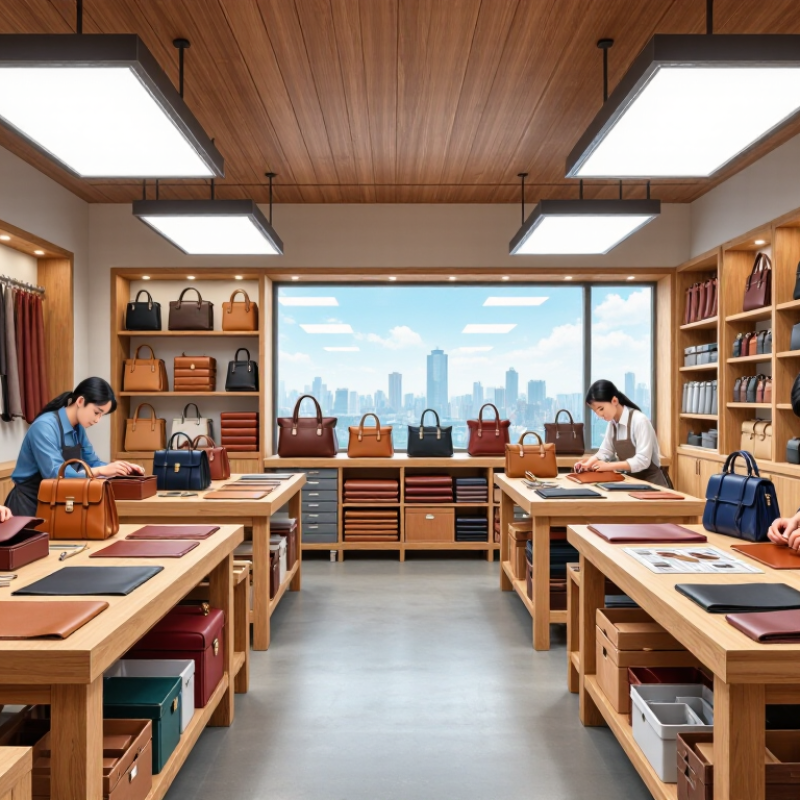
China’s custom leather bag industry combines material sourcing, pattern development, cutting, stitching, and finishing across a broad manufacturing network. Production is common in coastal industrial regions, where workshops can access hardware suppliers, packaging services, and skilled labor. Capabilities differ widely. Some factories manage sampling and bulk orders in-house, while others use partner workshops for selected production steps.
For buyers, the sample room can reveal more than a polished catalogue. Check edge paint, zipper alignment, lining attachment, and whether a bag keeps its shape when lightly filled. Ask how leather grades are defined and whether material records or inspection reports are available. Small details matter. A good sample does not guarantee consistent bulk production, so agree on tolerances and approval steps before manufacturing begins.
Customization may cover dimensions, pockets, colors, closures, and packaging. Clear specifications help reduce avoidable revisions, though they cannot remove every production variation. Manufacturers also face practical challenges around material traceability, cutting waste, and consistent finishing. There is no single standard. Buyers should compare actual samples, communication habits, and quality-control procedures, not just quoted prices or promised lead times.
Top 10 Custom Leather Bag Manufacturers in China: Industry Overview
HS 4202 classifies bags and similar containers by product type and outer-surface material. This chart shows four six-digit subheadings covering leather-surface products; it is a classification overview, not a ranking or measure of market size.
Source: World Customs Organization Harmonized System, heading 4202. Confirm the current national tariff schedule when classifying specific products.
Key Criteria for Evaluating Leather Bag Manufacturers
Choosing a Chinese leather-bag manufacturer means checking repeatable quality, not just a polished sample. Bain–Altagamma’s 2024 luxury study estimated global personal luxury-goods sales at about €363 billion that year. This is not a bag-only figure, but it reflects the scale and competition in premium goods. Ask for recent production samples, inspection records, and clear defect limits. Check leather thickness, stitch spacing, edge finishing, lining seams, and hardware alignment. Small inconsistencies matter.
Assess sourcing and production controls, too. Request batch traceability and documentation for leather materials. Confirm monthly capacity, lead times, subcontracting practices, and how rejected goods are handled. An ISO 9001 certificate can indicate a quality-management system, but it does not prove that every bag will meet your specification. Verify claims with an audit or a controlled trial order. A detail buyers sometimes miss: handles should be tested under load, not judged by appearance alone.
Tips: Send each candidate the same specification sheet and sample brief. Compare results against agreed measurements, not memory. Keep one approved “golden sample” for production checks. It may feel overly cautious; still, written standards prevent costly misunderstandings.
Top 10 Custom Leather Bag Manufacturers in China
Top 10 Custom Leather Bag Manufacturers in China should be compared by more than price. Look for documented experience with leather selection, pattern development, stitching, edge finishing, and hardware installation. Ask each factory for close-up sample photos and a pre-production sample. Check whether it can explain leather grades, color variation, and acceptable defects in writing. Small details matter: uneven paint around a handle can spoil an otherwise clean bag.
Market data provides useful context, but it cannot verify an individual supplier. Fortune Business Insights estimated the global leather goods market at USD 468.49 billion in 2024 and projected continued growth through 2032. This broad category includes products beyond bags, so it should not be treated as a forecast for custom bag orders. Still, it signals why sourcing teams should check capacity and quality controls before placing larger orders. Ask for the factory’s inspection process, sample lead time, minimum order quantity, and a clear breakdown of material and labor costs.
A practical top-ten shortlist should also compare communication and production transparency. Request a sample using the intended leather thickness, lining, thread, and fittings; then inspect seams and stress points yourself. Check supplier credentials independently, and confirm that the named factory will handle the work. A polished catalog is not proof. Samples can disappoint. Even capable workshops may miss a detail, so record revisions and approval limits before bulk production.
Comparing Manufacturers by Products, Customization, and Capacity
A useful comparison of Chinese custom leather bag manufacturers starts with product fit, not catalogue size. Some factories focus on structured work totes, while others make soft crossbody bags, travel pieces, or small leather goods. Ask for recent samples with close-up stitching, edge paint, lining, hardware, and pocket construction. The details matter.
Grand View Research estimated the global leather goods market at USD 271.3 billion in 2023, with projected growth of 6.6% annually from 2024 to 2030. That figure covers more than bags, so it signals broad market demand, not guaranteed orders for any factory.
Customization should be compared in practical terms: material choices, logo application, color matching, pattern development, and packaging. Request a written sample timeline and a clear revision limit. A factory may offer many options but rely on outside workshops for certain processes; ask which steps happen in-house.
Capacity needs the same scrutiny. Compare the stated monthly output with your order size, seasonal workload, and acceptable lead time. Request recent production schedules or anonymized capacity records, rather than relying only on a sales estimate.
A low sample price can also obscure development fees or minimum order quantities. One gap remains: public capacity figures are rarely comparable across manufacturers, so verify them against your own product specifications.
How to Choose a Manufacturer for Your Business Needs
Choosing a custom leather bag manufacturer starts with a clear product brief. Specify dimensions, leather type, lining, hardware, stitching, and target order quantity. A sketch alone leaves too much open to interpretation. Include reference measurements and photos of details that matter, such as pocket depth or handle reinforcement.
Ask how the manufacturer handles sampling, material checks, and production changes. Request a sample made with the intended leather and hardware, not convenient substitutes. Check the edge paint, seam consistency, zipper movement, and how the bag holds its shape when filled. Small detail. Big signal. Confirm the sample timeline, minimum order, payment schedule, and what happens if approved specifications change. Written records help prevent avoidable disputes.
A polished sample is useful, but it cannot prove every production run will match. Ask how defects are recorded and corrected, and whether you can review a pre-production sample before bulk work begins. Communication matters too: clear replies with measurements and dates are more useful than broad promises. For a first order, a smaller test run may reduce risk, though it can raise the unit cost. That trade-off deserves a real calculation. Compare manufacturers against your needs, not just their quoted price.